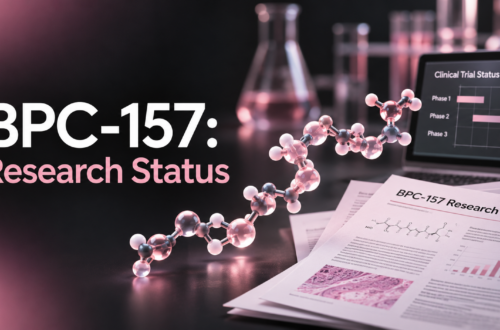
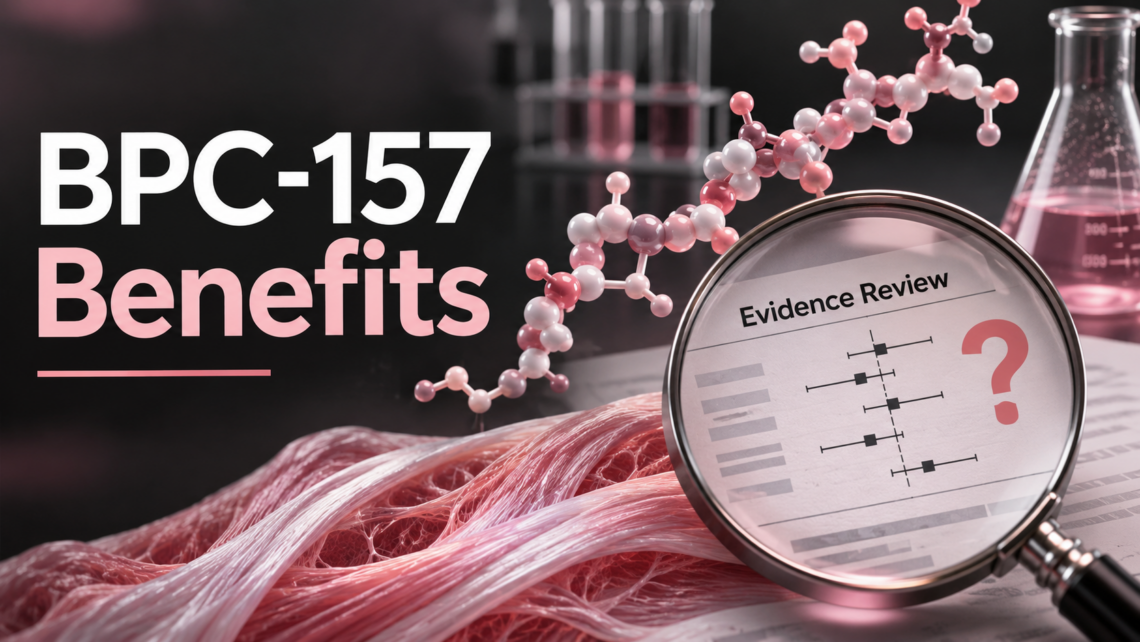
Claims about BPC-157 benefits are based mainly on animal and laboratory research, not strong human clinical evidence. Studies in rodents have explored tendon, ligament, muscle, bone, joint and gastrointestinal models, but an October 2026 systematic review found only three small human studies with 30 participants total and rated the certainty of evidence very low.
Last updated: November 7, 2026. This evidence review is educational and does not recommend BPC-157 or provide dosage, preparation or administration guidance.
What Benefits Are Commonly Claimed for BPC-157?
Online discussions often associate BPC-157 with faster recovery, tendon and ligament repair, muscle healing, joint comfort, gastrointestinal protection and lower inflammation. These claims are much broader than the available human evidence.
The key question is not whether a biological effect has appeared in any experiment. It is whether a well-designed human study has shown a meaningful, reproducible clinical outcome with an adequately characterized product and acceptable safety profile.
For basic terminology and regulatory background, read BPC-157 research status and evidence explained.
BPC-157 Benefits: Evidence at a Glance
| Claim | Main evidence | What can be concluded? |
|---|---|---|
| Tendon and ligament repair | Primarily rodent injury models | Promising preclinical signals, but no reliable proof of benefit in people. |
| Muscle recovery | Animal studies; recruiting Phase 2 human trial | The registered trial has not produced results, so effectiveness remains unknown. |
| Joint or knee symptoms | Small retrospective uncontrolled report | Cannot separate a treatment effect from placebo effects, natural recovery or selection bias. |
| Gastrointestinal or bladder conditions | Animal models and a small interstitial-cystitis pilot | Condition-specific preliminary findings do not establish a general gastrointestinal benefit. |
| General healing or anti-inflammatory effects | Mechanistic and animal research | Broad human claims are not supported by controlled clinical evidence. |
Claim 1: Tendon and Ligament Healing
Preclinical studies have investigated BPC-157 in rodent models of tendon and ligament injury. Researchers have reported changes involving tissue organization, blood-vessel signaling, fibroblast activity and functional recovery in some models.
These experiments can help identify possible mechanisms, but they do not prove that BPC-157 repairs a human tendon or ligament. Laboratory injuries are created under controlled conditions, and animals may receive a standardized research material that differs from commercially sold products. Human anatomy, rehabilitation demands, underlying health and injury severity add further uncertainty.
Evidence conclusion: tendon and ligament benefits remain preclinical.
Claim 2: Faster Muscle Recovery
Animal research has explored muscle injury and repair, creating interest among athletes. However, completed controlled human evidence is not available.
ClinicalTrials.gov lists a randomized, double-blind, placebo-controlled Phase 2 trial evaluating BPC-157 alongside standardized rehabilitation for an acute grade II hamstring strain. The registry lists estimated completion in 2028. Until results are posted, peer reviewed and independently assessed, the trial cannot support a benefit claim.
Evidence conclusion: muscle-recovery claims are unproven in humans.
Claim 3: Joint and Knee-Pain Improvement
A small retrospective report is part of the limited human evidence summarized in the 2026 systematic review. Some participants reported improvement after an intra-articular intervention, but the study lacked randomization, blinding and a placebo control. Retrospective reports are especially vulnerable to selection bias, incomplete follow-up and inconsistent outcome measurement.
Without a comparison group, researchers cannot know how much change resulted from natural recovery, concurrent care, expectations or the intervention itself.
Evidence conclusion: the available report is hypothesis-generating, not proof of a joint benefit.
Claim 4: Gastrointestinal and Bladder Benefits
BPC-157 has a substantial preclinical literature involving gastric and intestinal injury models. A small human pilot also evaluated symptoms in 12 women with interstitial cystitis. That study was limited by its size and design and addressed a specific bladder condition, not general gut health.
Evidence for one route, tissue or condition should not be applied to another. Animal gastrointestinal findings also cannot establish treatment effects for ulcers, inflammatory bowel disease, reflux or nonspecific digestive symptoms in people.
Evidence conclusion: human clinical evidence is insufficient for gastrointestinal or bladder-treatment claims.
Claim 5: Reduced Inflammation and Better Overall Healing
Research papers discuss possible relationships with nitric-oxide signaling, angiogenesis, inflammatory mediators and growth-factor pathways. These mechanisms may help explain laboratory observations, but mechanistic plausibility is not a clinical outcome.
Terms such as “healing peptide” or “regenerative peptide” can make preliminary biology sound like established medicine. A valid clinical benefit requires controlled human trials that measure outcomes meaningful to patients, not only pathway changes or tissue markers.
Evidence conclusion: broad healing and anti-inflammatory claims exceed the evidence.
Why the Human Evidence Is Rated Very Low Certainty
The 2026 systematic review of human BPC-157 evidence identified three studies with 30 participants total. The reviewers highlighted serious problems with risk of bias, indirectness and imprecision. Important limitations include:
- very small participant numbers;
- retrospective or uncontrolled designs;
- lack of validated outcome measures in key reports;
- different conditions and routes that cannot be combined reliably;
- limited adverse-event detection;
- no established long-term safety data;
- uncertain standardization of studied preparations.
A two-participant intravenous pilot reported no measured problems during its short observation period, but two participants cannot establish a general safety profile or detect rare harms.
Safety and Product-Quality Gaps
FDA states that compounded drugs containing BPC-157 may present concerns involving immunogenicity, peptide-related impurities and characterization of the active ingredient. FDA also says it has insufficient safety information for proposed routes to know whether the substance would cause harm in humans.
Online product availability does not resolve these concerns. A product may differ in identity, purity, salt form, sterility, endotoxin level, stability or storage history. Those differences can make both benefit and safety claims unreliable.
What Athletes Need to Know
BPC-157 appears under S0, Non-Approved Substances, in the World Anti-Doping Agency’s 2026 Prohibited List. It is prohibited at all times for athletes governed by WADA rules. “Research use only,” compounded status or an online prescription claim does not automatically create an anti-doping exemption.
How to Read a BPC-157 Benefit Claim
Ask these questions before accepting a headline or testimonial:
- Was the study performed in people, animals or cells?
- Was it randomized, blinded and placebo controlled?
- How many people participated?
- Was the outcome clinically meaningful and measured with a validated method?
- Was the exact product characterized for identity, purity and stability?
- Were adverse events monitored long enough to detect important risks?
- Has the finding been independently replicated?
Testimonials cannot answer these questions and cannot establish cause and effect.
Frequently Asked Questions
What are the proven benefits of BPC-157?
No BPC-157 benefit has been established through strong, completed human clinical evidence. Most positive findings remain preclinical.
Does BPC-157 heal tendons?
Animal studies have explored tendon repair, but reliable controlled human evidence is lacking. A claim that it heals human tendons is not currently supported.
Does BPC-157 help muscle injuries?
A Phase 2 hamstring-strain trial is recruiting, but results are not available. Current human effectiveness remains unknown.
Is BPC-157 safe?
There is not enough high-quality human evidence to establish a reliable safety profile, validated formulation or long-term risk estimate. FDA identifies additional concerns involving immunogenicity and product impurities.
Why do animal results not prove human benefits?
Species biology, injury models, product formulation, exposure and outcome measurement can differ substantially. Controlled human trials are needed before a clinical claim can be made.
Bottom Line
Claimed BPC-157 benefits are supported mainly by animal and laboratory studies. The small human evidence base is methodologically weak and rated very low certainty. Until well-designed trials report reproducible benefits and adequate safety data, BPC-157 should be described as investigational rather than as a proven healing or recovery treatment.
Sources
- 2026 systematic review of human BPC-157 efficacy and safety evidence
- Systematic review of BPC-157 in orthopaedic sports medicine
- ClinicalTrials.gov: recruiting Phase 2 hamstring-strain study
- Pilot study involving interstitial cystitis symptoms
- FDA: significant safety risks associated with certain bulk drug substances
- World Anti-Doping Agency 2026 Prohibited List