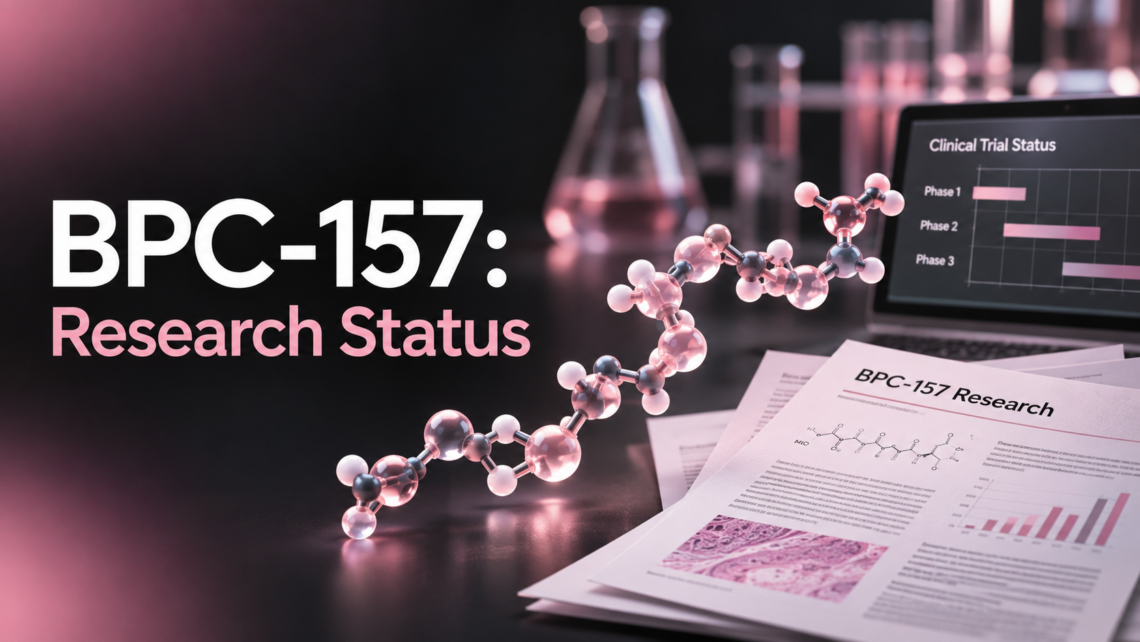
BPC-157 is a synthetic peptide made from 15 amino acids and is being investigated for possible tissue-protective and repair-related effects. Most published findings come from laboratory and animal models. Human evidence remains very limited, BPC-157 is not an FDA-approved treatment, and a registered Phase 2 study does not yet provide completed efficacy or safety results.
Last updated: November 7, 2026. This article is educational and does not provide medical advice, dosage, preparation or administration instructions.
What Is BPC-157?
BPC-157 is commonly described in the research literature as a synthetic pentadecapeptide. “Pentadecapeptide” means a chain of 15 amino acids. The sequence was developed from research connected with a gastric protein fragment, which is why older papers may use terms such as gastric pentadecapeptide or body protection compound.
The name is widely used online, but popularity is not the same as regulatory approval or clinical validation. BPC-157 products promoted by research suppliers, wellness businesses or compounding sources should not be assumed to have the same identity, purity, stability or quality as a standardized investigational drug used in a regulated trial.
What Is the Current Research Status?
| Evidence level | Current position |
|---|---|
| Cell and laboratory research | Explores signaling pathways and possible biological mechanisms. These findings cannot establish effects in people. |
| Animal studies | Many published studies involve rodents and injury models. Results remain preclinical. |
| Small human studies | A 2026 systematic review identified three studies with 30 participants total. All had major methodological limitations. |
| Registered controlled trial | ClinicalTrials.gov lists a recruiting Phase 2 hamstring-strain study with estimated completion in 2028. No results are available yet. |
| Regulatory approval | BPC-157 is not an FDA-approved medicine and does not have an established approved human use. |
What Has Preclinical Research Investigated?
Animal and laboratory studies have explored BPC-157 in models involving tendons, ligaments, skeletal muscle, bone, gastrointestinal tissue, blood vessels and inflammatory signaling. Researchers have proposed relationships with nitric-oxide pathways, angiogenesis, growth-factor signaling and tissue-protection processes.
These categories describe research questions, not proven benefits. Animal models are useful for generating hypotheses, but species differences, experimental injury methods, formulation quality and route of exposure can prevent findings from translating to people.
For a claim-by-claim assessment, see the separate review of BPC-157 benefits and evidence limitations.
How Much Human Evidence Exists?
An October 2026 systematic review searched major databases and ClinicalTrials.gov for human BPC-157 evidence. It included three small studies involving 30 participants:
- a retrospective report involving knee pain;
- a small pilot involving interstitial cystitis;
- a two-participant intravenous safety pilot.
The review rated the overall certainty of evidence as very low because the studies were small, uncontrolled or retrospective and had serious risk of bias. Results from these reports cannot establish general effectiveness, identify a reliable risk profile or support a validated treatment protocol.
The two-person safety pilot is particularly limited. A study with two previously exposed participants cannot detect uncommon adverse effects or establish long-term safety across different populations.
What Does the Registered Phase 2 Trial Mean?
ClinicalTrials.gov lists a randomized, double-blind, placebo-controlled Phase 2 trial studying BPC-157 alongside standardized rehabilitation for acute grade II hamstring strain. The registry lists an estimated enrollment of 120 and an estimated study completion in 2028.
A registered or recruiting trial is evidence that a question is being formally studied. It is not evidence that the intervention works. Conclusions should wait for completed results, peer review, full safety reporting and independent replication.
FDA and Compounding Context
FDA materials state that compounded drugs containing BPC-157 may raise risks related to immunogenicity, peptide impurities and characterization of the active pharmaceutical ingredient. The agency says it has identified no or only limited safety information for proposed routes and lacks enough information to know whether BPC-157 would cause harm when administered to humans.
At a July 2026 Pharmacy Compounding Advisory Committee meeting, FDA reviewed BPC-157-related bulk drug substances. FDA briefing materials stated that BPC-157 is not a component of an approved drug product. The existence of a compounded or commercially marketed product does not mean that FDA has approved its safety, effectiveness or quality.
Anti-Doping Status for Athletes
The World Anti-Doping Agency’s 2026 Prohibited List places BPC-157 under S0, Non-Approved Substances. It is prohibited at all times for athletes subject to WADA rules. Competitive athletes should verify any substance through their governing anti-doping organization rather than relying on a seller’s description.
Why Product Quality Is Part of the Evidence Question
Even when a research paper reports a specific sequence, dose form or analytical standard, an online product may not match it. Important variables include:
- identity and sequence confirmation;
- purity and peptide-related impurities;
- sterility and endotoxin control where applicable;
- salt form, excipients and container compatibility;
- stability during storage and transport;
- independent batch documentation.
Without validated pharmaceutical characterization, it becomes difficult to connect a marketed product to published research or to interpret safety accurately.
Frequently Asked Questions
Is BPC-157 FDA approved?
No. BPC-157 is not an FDA-approved medicine and does not have an established approved human indication.
Is BPC-157 a peptide?
Yes. It is described as a synthetic pentadecapeptide, meaning a chain of 15 amino acids.
Are there human clinical trials for BPC-157?
Human evidence includes a few very small and methodologically weak reports. ClinicalTrials.gov also lists a recruiting randomized Phase 2 hamstring-strain study, but it has not produced completed results.
Does animal research prove BPC-157 works in people?
No. Animal studies can support a research hypothesis, but controlled human trials are required to determine clinical effectiveness and safety.
Is BPC-157 allowed in competitive sport?
No for athletes governed by WADA rules. The 2026 Prohibited List includes BPC-157 under non-approved substances prohibited at all times.
Bottom Line
BPC-157 is an investigational 15-amino-acid peptide with a large preclinical literature but very limited human evidence. It is not an FDA-approved treatment, current human evidence is rated very low certainty, and important safety and product-quality questions remain unresolved. A recruiting Phase 2 trial may add information in the future, but it does not yet change those conclusions.