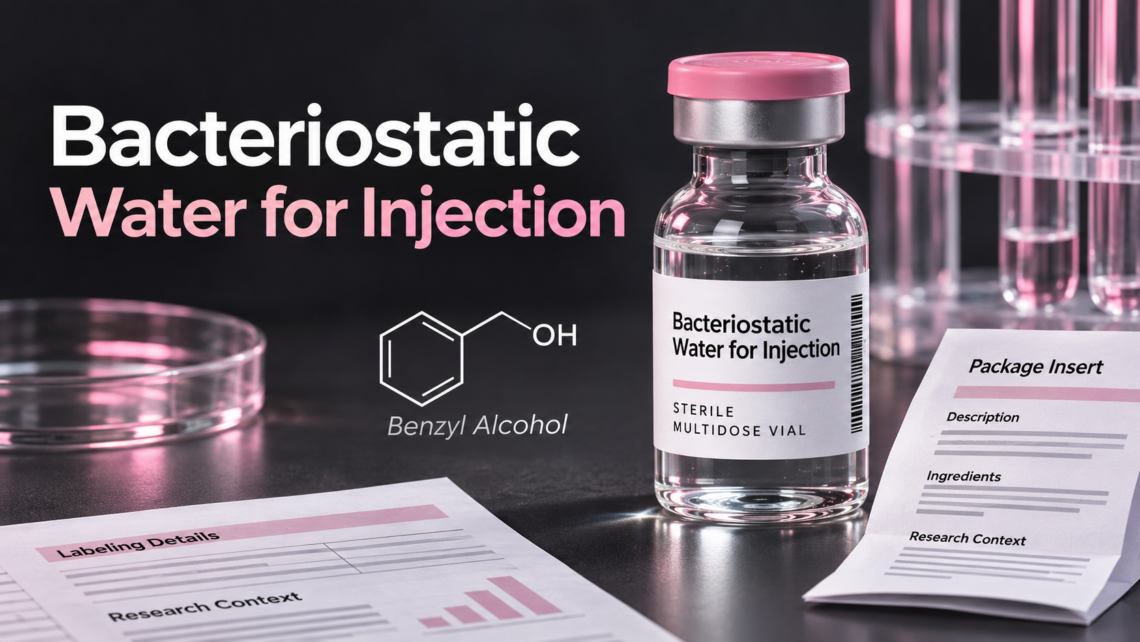
Bacteriostatic Water for Injection, USP is a sterile, nonpyrogenic water product that contains an antimicrobial preservative and is labeled as a vehicle for diluting or dissolving compatible injectable drugs. It is usually supplied in a multi-dose vial. It is not a medication by itself, not plain sterile water and not appropriate for every drug or patient.
Last updated: November 6, 2026. This label guide is educational. It does not provide preparation, dosage, injection or treatment instructions.
What Is Bacteriostatic Water for Injection?
The United States Pharmacopeia defines Bacteriostatic Water for Injection as Water for Injection that is sterilized, suitably packaged and contains one or more suitable antimicrobial agents. A current DailyMed label describes a sterile, nonpyrogenic preparation with 0.9% or 1.1% benzyl alcohol, depending on the labeled presentation.
The preservative is why many products are supplied as multi-dose containers. It helps limit bacterial growth after repeated access, but it does not make contamination impossible. Read the broader guide to bacteriostatic water uses, storage and safety for a beginner-level overview.
What the Official Label Says
| Label element | Meaning |
|---|---|
| For Injection, USP | The product is made for a defined pharmaceutical role and is subject to applicable compendial standards. |
| Rx only | The labeled product is a prescription drug product in the United States. |
| Multiple-dose vial | The labeled container is designed for repeated withdrawals under appropriate aseptic conditions. |
| Benzyl alcohol added | Benzyl alcohol acts as the antimicrobial preservative and also creates important population and compatibility restrictions. |
| For drug diluent use only | The product is a vehicle, not a stand-alone treatment or fluid-replacement product. |
How It Differs From Other Sterile Water Products
Bacteriostatic Water for Injection vs Sterile Water for Injection
The central difference is the preservative. Bacteriostatic water contains an antimicrobial agent and is often supplied in a multi-dose container. Sterile Water for Injection is preservative-free and is commonly supplied as a single-dose product. That distinction affects labeling, patient restrictions and how the container is handled.
Bacteriostatic water vs bacteriostatic saline
Bacteriostatic saline contains sodium chloride as well as a preservative, while bacteriostatic water does not contain sodium chloride. They are not automatically interchangeable. The manufacturer instructions for the exact drug determine the correct vehicle.
Bacteriostatic water vs ordinary distilled water
Distilled water sold for household or general laboratory use is not an equivalent pharmaceutical product. It does not carry the same sterile, nonpyrogenic, packaging and labeling requirements.
Why Compatibility Must Be Checked Product by Product
The DailyMed label directs users to consult the drug manufacturer’s instructions for the choice of vehicle, concentration, volume, route and rate. It also warns that some drugs may be incompatible with a particular vehicle or with benzyl alcohol.
This is why a statement such as “use bacteriostatic water” should never be copied from one drug, peptide or research protocol to another. Compatibility can depend on:
- the identity and formulation of the added compound;
- the concentration and final pH;
- the presence of benzyl alcohol or another preservative;
- the intended route and final tonicity;
- container materials, temperature and light exposure;
- the manufacturer’s validated stability data.
Our separate guide to bacteriostatic water in peptide research discussions explains this product-specific context without offering preparation instructions.
Storage and Multi-Dose Vial Rules
The current DailyMed product cited here states storage at 20 to 25°C (68 to 77°F). That statement applies to the labeled bacteriostatic-water product before it is combined with another substance. A prepared drug solution may have a different temperature range and beyond-use period.
CDC guidance states that an opened multi-dose vial should generally be dated and discarded within 28 days unless the manufacturer provides another opened-vial date. It should never be used beyond the original expiration date. CDC also emphasizes that a preservative does not protect against viruses or provide complete protection against bacterial contamination.
If a seal is damaged, the solution is not clear or sterility is questionable, the product should not be used. Official labeling and institutional sterile-practice rules take priority over general web advice.
Warnings and Regulatory Context
Not for use in neonates
Current labeling warns that solutions containing benzyl alcohol must not be used in neonates because of potential toxicity. Where water is required for preparing or diluting medications for neonates, the label specifies preservative-free Sterile Water for Injection.
Not for direct intravenous injection
The label warns that intravenous administration of bacteriostatic water without a solute may cause hemolysis. It also states that an intravenous admixture must be made approximately isotonic. These statements reinforce that this product is a vehicle governed by the added drug’s directions, not a stand-alone injection.
Not for fluid replacement, epidural or spinal anesthesia
The label lists these as contraindicated uses for benzyl-alcohol-containing parenteral preparations. Readers should rely on current product labeling because available presentations and warnings can change.
What “Research Context” Means
Bacteriostatic water often appears in peptide, protein and laboratory-product discussions. Research context does not remove the need for traceable product identity, sterility documentation, validated compatibility and controlled handling. A vial labeled “research use only” is not the same as an FDA-approved prescription product and should not be represented as suitable for people.
For SEO and scientific accuracy, it is important to keep these categories separate: a pharmaceutical label describes an approved product, while a research supplier page may describe a material intended only for laboratory work.
Frequently Asked Questions
Is Bacteriostatic Water for Injection a drug?
In U.S. labeling, it is an Rx-only pharmaceutical product used as a diluent or solvent for compatible drugs. It has no therapeutic action by itself.
Can Bacteriostatic Water for Injection be injected alone?
No. Current labeling warns against intravenous administration without a solute because it may cause hemolysis. It is labeled for use only with compatible drugs and according to their manufacturer instructions.
Does bacteriostatic water contain saline?
No. Bacteriostatic water is water with an antimicrobial preservative. Bacteriostatic saline is a different product containing sodium chloride.
Why is benzyl alcohol included?
It acts as a bacteriostatic preservative that helps limit bacterial growth in a multi-dose container. It does not eliminate the need for aseptic handling or prevent all contamination.
How should Bacteriostatic Water for Injection be stored?
Use the exact product label. The current DailyMed presentation cited here states 20 to 25°C (68 to 77°F). Prepared solutions must follow the added drug manufacturer’s stability and storage instructions.
Bottom Line
Bacteriostatic Water for Injection is a defined, preserved pharmaceutical vehicle with specific labeling, storage conditions and warnings. It is not interchangeable with sterile water, saline or general laboratory water. The exact drug instructions determine compatibility, and the product should never be treated as a stand-alone injection.